|
||
19. Schlieren "flames" |
| Listing of Structures |
| Back...Next |
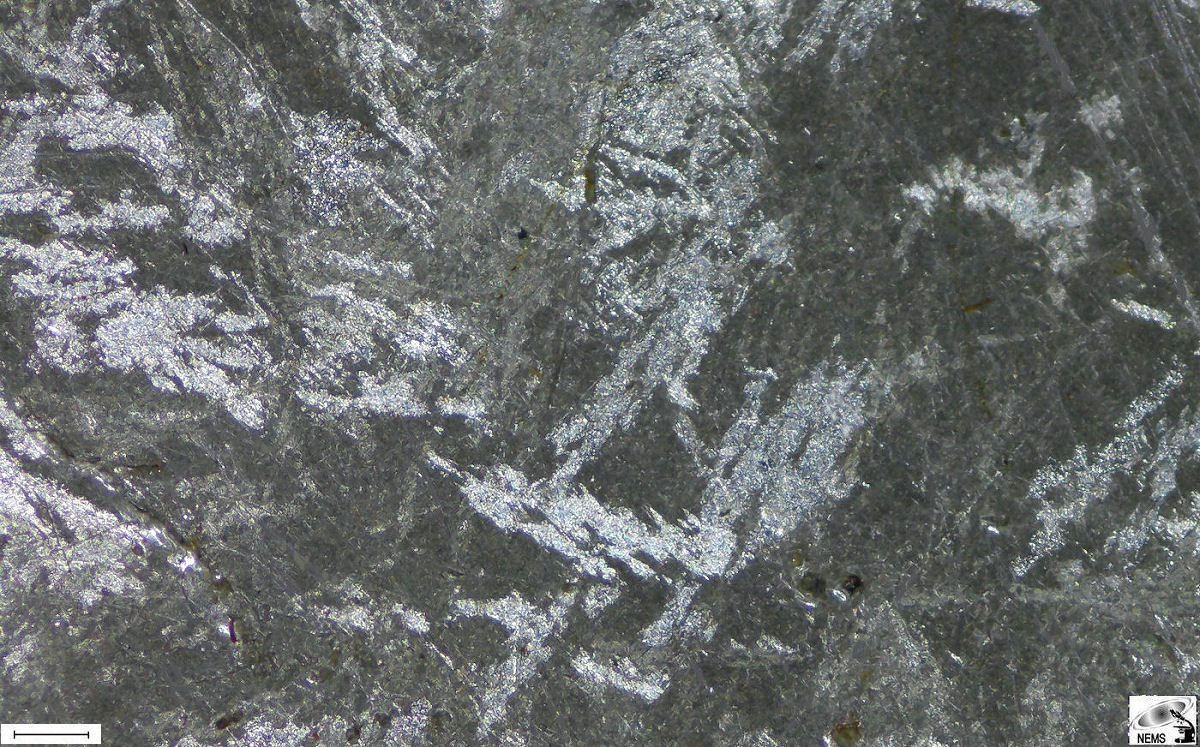
| Meteorite - Ysleta, ungrouped iron. |
|
| Figure 1. |
| Schlieren Flames in the Ysleta Ungrouped Iron Meteorite |
| These primary features formed during the nucleation and transformation from austenite to kamacite. The flame-like morphologies occur within millimeter-scale domains of fine-grained duplex (α + γ) mixtures. Scale bar=600 µm. |
Etymology and Usage of “Schlieren” The term schlieren (singular: schliere) originates from Middle High German slier, meaning “streak,” “stria,” or “veil.” It is widely used across scientific disciplines—including geology, petrography, fluid dynamics, metallurgy, optics, chemistry, and meteoritics—to describe streaks, bands, or irregular masses that are distinguishable from their surroundings due to subtle differences in composition, density, refractive index, or texture. In meteoritics, schlieren typically denotes gradational textural or compositional features that transition diffusely into the host matrix, often reflecting primary solidification or transformation processes rather than sharp boundaries. Microstructure of Ysleta Ysleta is a polycrystalline ungrouped iron meteorite characterized by a plessitic matrix—a fine intergrowth of kamacite (α-FeNi, body-centered cubic) and taenite (γ-FeNi, face-centered cubic). Polished and lightly etched sections reveal no prominent macroscopic structure such as a Widmanstätten pattern. Instead, they display numerous large parent austenite (γ) grains, typically 1–2 cm in diameter. During slow cooling from high temperatures, the austenite underwent solid-state transformation. Nucleation of kamacite initiated preferentially along austenite grain boundaries, forming delicate kamacite veins only 10–50 µm wide (Buchwald, 1975). With continued cooling, the interiors of the austenite grains transformed into micron-scale plessitic intergrowths. Within localized millimeter-sized regions of this duplex α + γ matrix, distinctive flame-like schlieren structures developed. These are not simple linear streaks but irregular, gradational, flame-shaped domains that stand out texturally from the surrounding fine-grained mixture. Petrogenetic Interpretation The “schlieren flames” in Ysleta are interpreted as primary structures that formed during the high-temperature nucleation and early stages of the austenite-to-kamacite transformation. Their morphology likely reflects localized variations in Ni diffusion, cooling rate gradients, or minor compositional heterogeneities (e.g., in P or other trace elements) within individual parent grains. Such features highlight the complexity of transformation textures in ungrouped irons, which often deviate from the equilibrium expectations of well-grouped magmatic irons. Significance The study of schlieren and related transformation microstructures in irons like Ysleta provides insights into: • Parent-body cooling rates and thermal histories • The role of grain boundaries and minor elements in controlling nucleation and growth. • The diversity of processes affecting metallic materials in the early solar system, particularly for ungrouped specimens that may sample distinct or anomalous parent bodies. High-resolution metallography, combined with electron backscatter diffraction (EBSD) and microprobe analysis, can further resolve the crystallographic orientation relationships and compositional gradients responsible for these visually striking features. |
| References Buchwald, V. F. (1975). Handbook of Iron Meteorites: Their History, Distribution, Composition and Structure. University of California Press. |
| Buchwald, V. F. (1981). Note on Schlieren bands. Meteoritics 16: 298–299. |
| Listing of Structures |